—
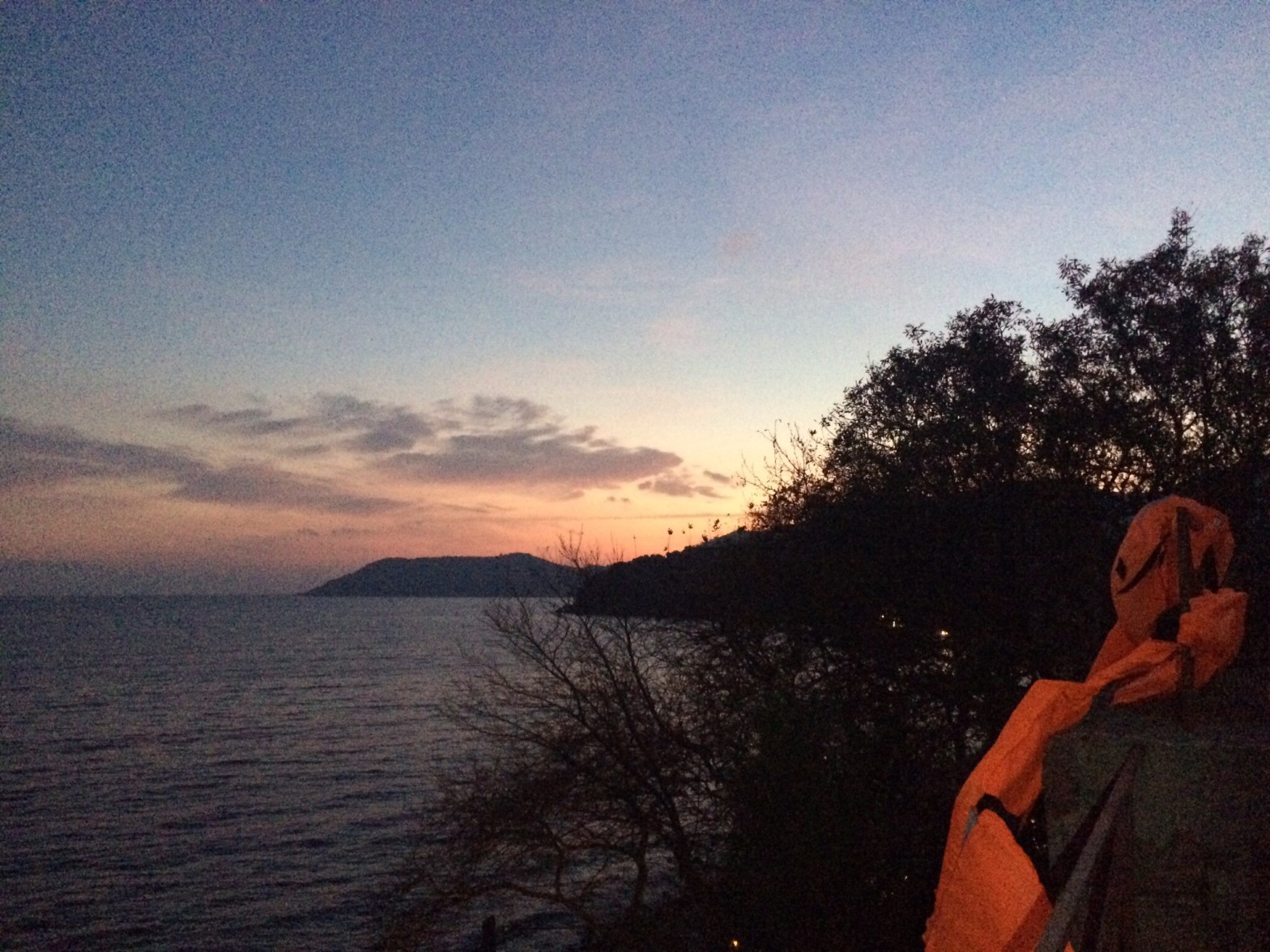
As the plane from Athens to Mytilene Airport begins to descend and you look out the window, you see the great mountainous island below you; the outline of its north and west coasts is drawn, even from this great distance, by bright orange life vests cast in great piles along the rocky shores.
—
Everyone is always scanning the horizon. Driving or walking or sitting or standing along the ocean, your eyes immediately become always open to the possibility of boats.
—
You wave to the old woman as she gets into a taxi, leaving the camp on the way to the port where she will wait for a ferry to Athens, continuing her journey into Europe — “shukran” she says, raising her hand and pressing it flat against the car window. Her wrinkled, aged face looks like a collage of exhaustion, fear, and determination.
—
Here I sit at 3:30 in the morning beside the fire as waves roll into the shore just near us. Occasionally we hear a noise that could be a motor or could be voices or could be a rubber boat thumping on the water and I raise my head, giving all of my attention to the air. If it sounds substantial enough, I go out to the beach, look around, listen, scan the horizon with the night vision goggles, pay attention. When I feel sure there isn’t a boat immediately approaching, I return to my seat by the fire, waiting, alert, patient, open to what might be out on the waters. It’s an incredible thing, to keep watch, to be attentive to, to literally hold space all night long so that we are awake and ready to wrap our welcome around any who have gotten into a rubber boat and set out hopeful for the possibility of peace that might lie on these shores. There are fires lit tonight all across this island and others, surrounded by humans keeping watch for other humans — what an incredibly beautiful thing to think about.
—
The waters here are speckled with the orange of floating, empty life vests.
—
The small rubber dinghy, barely visible underneath the weight of some sixty people piled into and atop it, approaches the shore; the men, women, children, babies, just inches from surviving the perilous journey across the waters to land safely upon European ground where the rest of their treacherous travels are only just beginning, begin to cheer, clap, weep, and whistle. As their feet safely hit the ground, families hug and kiss one another, incredulous, relieved, and and smiling as they find themselves alive on the other side.
It is a moment, so deeply filled with simultaneous sorrow and joy, unlike any other.
—
We learn a boat is stuck on the rocks by the northern coast’s lighthouse, a shining light in the darkness that, unfortunately, dangerously, sorrowfully, becomes the only clear indicator of land for refugees crossing the ocean at night; rather than detract boats from the threats of the rocky cliffs where the lighthouse rests, as is its purpose, the majority of refugees who set sea at night toward the north coast of Lesvos direct their small dinghies directly there, as its bright light provides the only sureness of European earth on which to land.
We are told the boat has hit the rocks, some distance from the beaches and out of reach of the medics and volunteers who rest there each night, waiting to do all they can to safely welcome any boats that may, and do, come, often having to climb the cliffs for miles until vehicles or rescue boats can safely bring the groups of refugees to one of the nearby camps.
We call the coast guard and the volunteer lifeguards from Spain, who spend their days and nights searching for and escorting boats across the ocean, who also say their boats are already out, rescuing other boats, and that the rocks near the lighthouse are often too dangerous for them, as well. We’re told a rescue attempt such as this might only put more in danger and bring no one to safety.
You wonder: will we sit by all night and watch you drown through our binoculars?
—
Suddenly, five boats are on the horizon, the orange crowd of life vests bobbing up and down through our binoculars. Suddenly, five boats are landing all at once and one of the men coming off one of the boats begins to have a heart attack, collapsing on the rocks. Seeing medics are with him, I walk with the other families to the camp, helping the mothers to change their soaking wet and freezing children into dry clothing. Later, I see a group of six medics carrying the man on a stretcher down the road toward the clinic. Behind them, the man’s two young children run along, their little legs trying to keep up with the rushing medical team. The older boy, maybe seven or eight, wears a serious, knowing expression. The younger, maybe four or five, skips along, laughing and trying to race his brother, happy to be on steady ground and thinking this running some sort of game, giggling unaware.
—
We humans are capable of going such great distances for one another. Families will travel such great distances for their survival and peace. Mothers will delay getting dry and demand more clothing until their babies are well and okay. Fathers will lug hundred-pound luggage full of a family’s whole life in and out of soaking boats. Children will hold babies and uncles will bring nieces when their parents have died and friends will hold up the legs of the man whose failing heart causes his eyes to droop and his consciousness to fade in and out. And even when we are strangers, even enemies by declaration of our governments, the young men will kindly talk to the shaking, terrified, lost little boy, searching for a language he understands and to who me he might belong.
We will stay up all night, cross oceans, survive bombs, walk for miles in the cold, sew our mouths shut, all for hope and love of life. How hauntingly beautiful. If only we could all see how not so very different we are — we’re all just clambering to live, aren’t we?
—
It’s 5:30am, we’re sitting around a fire with a group of Syrians whose boat has just landed in front of the small transitory camp where we have welcomed them for the night, providing dry clothes, food, warmth, all the care we have to give, and the man next to me quietly presses his strand of prayer beads into my hand, says he wants me to have them. I say “no, I can’t take these. They are yours, I want you to have them for your journey.” He replies: “this way you will not forget us, you will remember to think of and pray for us.” “There is no way I could not”, I say, and place the beads in my pocket.
—
The little girl sits in your lap as we wait outside the shipping container that has been converted into a clinic, inside which her brother is receiving stitches. We play with the slinky, her eyes slowly growing wider in delight and a grin forming at the corners of her mouth as she watches the plastic toy stretch wide and boing out of her hands. And then, a small, tinkling giggle bursts forth from her little body and it’s as if, if only for those few seconds, we are surrounded in sunlight.
—
Now, I write this sitting in the small cafe that has become the living room for the many aid workers, lifeguards, volunteers, journalists, local fisherman and families who now live in and filter through this tiny fishing village whose beaches, only eight kilometers from the northern coast of Turkey, receive hundreds of refugees each day. Everyone in the cafe has turned their chairs to face outward toward the sea and every few minutes, someone stands up to get a better look, thinking they’ve seen a rubber boat arriving or watching a rescue boat as it speeds across the waves. The rest of us seated here also stand up, crane our necks to look, all becoming alert to the possibility that another thirty, fifty, seventy, one hundred people, the elderly clutching wheel chairs, terrified children, young men covered in war wounds, women carrying unborn babies, humans, have gotten into a tiny, sinking rubber boat, crossing the seas in search of survival. A local fisherman sees it is only a coast guard boat, out patrolling the waters, and not a ‘refugee boat’, as they are called, and the cafe settles again, returning to their coffee, cigarettes, computers, quiet conversations about the boat that sank a few kilometers off these shores yesterday, until, a few minutes later, someone else stands, squinting into the horizon, and we all once again straighten in our chairs, looking out.
Suddenly we see lifeguards running toward their boats, aid workers rushing toward the beach, and a man pokes his head in the cafe door: boats. Everyone stands up, leaving their belongings and unpaid bills where they are, to rush to where the rescue boat, full of people whose dinghy capsized some minutes before, has landed. When it is clear that everyone on board is okay and on their way to one of the transition camps along the coast, the cafe’s morning visitors return to their seats.
A little while later, the middle-aged Syrian man, who is sitting at the table next to mine with his younger brother and three volunteers, suddenly bursts into sobs. One of the volunteers goes to him, hugging him, and his brother places a hand on his shoulder, speaking to him quietly in Arabic. The two men are here searching for their two young children who went missing last month when the boat the family took from Turkey to Lesvos sank; half the boat, including this father and his brother, and the children’s mother, was rescued by the Turkish coast guard and returned to Turkey, while the other half, seemingly including the children, was rescued by the Greek coast guard and brought to the island. Some ten days ago, the father and brother once again made the journey across the sea, this time in search of the children, following rumors and hope the children had been seen on the island at some point in the last month, though the possibility still exists the children were never rescued but lost at sea, just as two were lost some few hundred meters off this coast only twenty-four hours ago.
And you think: what a tremendous display of humanity. But also: how long can this go on? How can this continue to be reality? For surely, surely, this cannot be sustainable.
 callie daniels-howell
Callie…My next door neighbor’s daughter also worked as you have with the refugees . I’ve sent this post on to her mother. See you soon.
Thank you, Callie, for your beautiful writing which makes this long-running news story a real human experience.
Callie you amaze me with your writing and all that you do, what a wonderful young women.
Take care of yourself.
Judith
Great stories of your experiences. Great stories for a book of Callie’s Capers. Looking forward to seeing you Christmas. Don Pershing
Callie, as I sit here in the comfort of my home after reading your blog entries about the refugees who are cold and wet and lonely, I am filled with emotion as anyone could see by the tears streaming from my eyes. I am filled with remorse about what humans are doing to other humans, but also with thanksgiving to God for you, for your willingness to be involved with people who need to know someone cares. You have done so much in your relatively few years and I know you will do so much more in the years to come. Please keep sharing with us at North Church.
Frances Cain