The large bus is careening and weaving, whipping over the twisting, compact roads. Occasionally, another bus barrels around a corner and down a hill from the opposite direction, and both vehicles are made to slow so that they might peacefully pass the other, only some four or five inches between the two, squeezed against the cobbled stone walls on either side, until they have fully moved apart from one another; then both once again speed away around another bend. Out the window to my right, against which I peer, awed, the Atlantic speeds along with us; the shore flashes, changing shape with every inch of our passing: black and rocky cliff, a shock of brilliant green grass, slate walls and tiny fences, field of sheep and cows out to pasture, foaming and lapping waters that swirl in shades of turquoise, cerulean, and jade. On the left, the bus sweeps past great slabs of whitish-gray stone speckled with a silver shine; open plains of wild and living clumps of nettle, rose hips, and blackberry bushes; tractors pushing over hayfields, seemingly peeling a layer of earth, as if an onion, into tight, golden rolls in their wake; towering mountains juxtaposing the almost endless expanse of blue stretching straight to the horizon, rendering differentiation between sky and sea, sea and sky, nearly impossible to delineate. Through the ten-hour ride, I watch as this magnitude unfolds further with each turn of the wheel, my eyelids opening wider and wider, as if my irises were gasping in astonishment at all they were meeting.
And through roughly eight and a half of these ten hours, Mariah and I were reasonably convinced that when we exited the bus at the end of its route in the tiny, rural, seaside village of Lehinch, on the west coast of Ireland, we would set foot on the ground, our packs strapped to our backs, and have no form of transport to the home we were meant to be staying in, let alone the address of said home, or any sort of sureness that we were, indeed, meant to be staying there for a week’s time. The possibility ran through our minds that upon our arrival in Lehinch at six in the evening, after twelve hours of travel, we would be stranded, without food, a place to sleep, or a form of communication that works outside of free wifi zones. Before leaving the States, we had arranged to stay in an Irish woman’s home just outside Lehinch, working in her garden a few hours a day in exchange for room and board through the volunteer program, Workaway. We contacted her a few days previous to our arrival to tell her of our travel plans, then again the morning of our departure to confirm her picking us up from the bus stop, then again when we were on the bus and still had received no word from her; we then realized we hadn’t actually had direct contact from her in about three weeks, at which point I considered the likelihood of us making #lostinLehinch trend in the next twenty-four hours. But we said to each other: we’ll just have to see what happens, off we go on the adventure.
And what an incredible bus ride it was; we were, quite literally, speeding off into the unknown, and I was unfazed, calm, peacefully sure that, somehow, it would all work out as I gazed out and in, immersed in the dazzling, inarticulable beauty overwhelming my senses. I allowed life to unfold before me, and I was deeply joyful.
And what repeated itself, again and again, in my mind, as it has so often through these first five weeks of our journey, was this: it is a grand privilege to be able to call this an adventure.
And it is. Not only is the journey itself one that we are incredibly fortunate, and grateful, to be able to take, but our freedom to willingly and knowingly speed off into the unknown, laughing and saying we’ll see is one that is afforded to us by systems and structures of privilege that are constantly at the forefront of our minds.
When we found ourselves in Victoria Station in London at midnight, preparing to take an overnight bus to the Lake District because we didn’t make plans until late the night before and found our only affordable lodging option was public transportation, we said: it’s all part of the adventure.
When we arrived in the Lake District, after said overnight bus, which cumulated in eighteen hours of travel and two hours of sleep, and discovered the only hostel with space for the evening was not the two-mile walk from the bus stop we were prepared for, but rather seven miles of hiking around half a lake with our packs on, we said: it’s all part of the adventure.
When the last train from the small coastal town of Dunbar, Scotland, back to Edinburgh, where we were staying and meant to leave early the next morning for Dublin, got stuck and we waited in the station for an hour wondering the likelihood of a successful hitchhiking experience, we said: it’s all part of the adventure.
In train stations, on buses, down confusing winding roads, crossing vast fields with glaring Irish cows, up a few mountains we weren’t entirely qualified to climb, we say it to ourselves, to each other, at least a few times every day: this is all part of the adventure.
And it is. And I have learned, and grown, and felt so very alive in these first five weeks of adventuring. But I wouldn’t be living the whole story of life if I wasn’t always mindful of, or didn’t name and acknowledge openly, the systems of power, privilege, and inequality that position some to be refugees struggling against barricades and dying for hope of a safer home for their families; to be people of all ages experiencing homelessness and joblessness; to be children the world over, impoverished and starving, unable to complete school successfully or at all; and that simultaneously position us to be those who are able to speed into the unknown, without fear or tremendous worry, calling it an adventure.
We are able to laugh and say off we go because while we may not know what will happen when we get off the bus in Lehinch, we know what we carry with us: we know that with us we carry credit cards with large enough limits to cover an expensive taxi ride or hotel if we ever were indeed stranded or without a place to sleep; we carry smart phones that could put us in contact with parents who will bail us out if absolutely needed; we carry American passports that easily grant us access and entry to most anywhere, as needed or wanted; we carry English fluency, granting us greater sureness of our needs and intentions being listened to and understood; we carry the combination of our skin tones, class levels, and gender identities that profile us, in the eyes of strangers part of these systems, to be safe and trustworthy of kindness they might extend.
This is not to say we have no cause for caution at times, and for wisdom always; as two women traveling alone, with American accents and large backpacks of belongings, almost immediately distinguishing us as foreign, potentially confused, and easy to prey upon in the eyes of those same strangers part of these systems, we most certainly do. That reality also shapes the whole story of life, a story that includes layers and intersections, nuances and truths, which continually unfold and change shape within each new social, historical, and political context where we find ourselves.
As such, there have also been frequent occasions over the last five weeks when I have thought: there is a difference between being adventurous and being careless. Our privilege to fearlessly speed into the unknown and call it an adventure is not something that we simply name and appreciate before continuing on our carefree way, nor is it something that absolves us of connection and responsibility.
While it may be our feet walking this ground, looking out and in from bus windows speeding off into the unknown, we do not journey detached; using the word adventure does not automatically establish us as islands.
Our identities position us such that the social and political systems of power, privilege, and inequality, which shape our individual and collective lives, do not, in most respects, cage or tether us, but rather encourage us to fly. Our privilege affords us the option and ability to flit around life, as if we were truly on our own, accountable to only, and ignoring everything but, ourselves, saying we are living freely, calling ourselves adventurous.
But I live intentionally out of a deep belief that my wellbeing is bound to that of all others, which means that every day, all day, I make choices with the hope and aim that every ounce of my living fulfills my commitment to the notion that by taking care of others, I take care of myself and by taking care of myself, I take care of others, that no one is free until we are all free. And so every overnight bus ticket we book, every mountain we climb unqualified, every road we walk down without a destination, every we’ll just have to see what happens we utter…all are lived by us as our own selves, laughing and calling it an adventure, but all were the result of a series of continual decisions made with many, many others in mind.
It is not just our belief and intentional living which renders any notion of ‘no strings attached’ untrue; all that we carry with us, as we speed adventurously off into the unknown, connects us. It connects us to bank accounts, visas, white anglo-saxon ancestral histories, a birth country that is a world hegemonic superpower. And it connects us to the social and political systems which we are privileged to ignore or forget if we choose, but which are very, very real, and, as such, connect us to refugees struggling and dying for hope of a safer home, to individuals of all ages experiencing homelessness and joblessness, to impoverished and malnourished children the world over, to those positioned to have both greater and lesser power and privilege, connects us to all others.
While it may be our feet walking this ground, looking out and in from bus windows speeding off into the unknown, we do not journey detached; using the word adventure does not automatically establish us as islands.
The bus creaked to a stop and we stepped down onto the small patch of pavement, looking around: a weathered telephone box, a small parking lot where two or three cars sat empty, and a bus stop sign with faded block letters reading ‘LEHINCH’. Five to ten minutes after the time we had informed our host we would arrive, seeing no one and nothing near us save for Irish countryside that still dazzled even as it darkened, we turned back to the bus driver: is this the only stop in Lehinch? It is. And as we were left alone on the side of the road, we began to wonder if we were about to live through what would later become the story of Mariah and Callie getting stranded in rural Ireland, the story we’d later tell our friends through romanticized details and spurts of laughter, the story we’d end with: it was all part of the adventure.
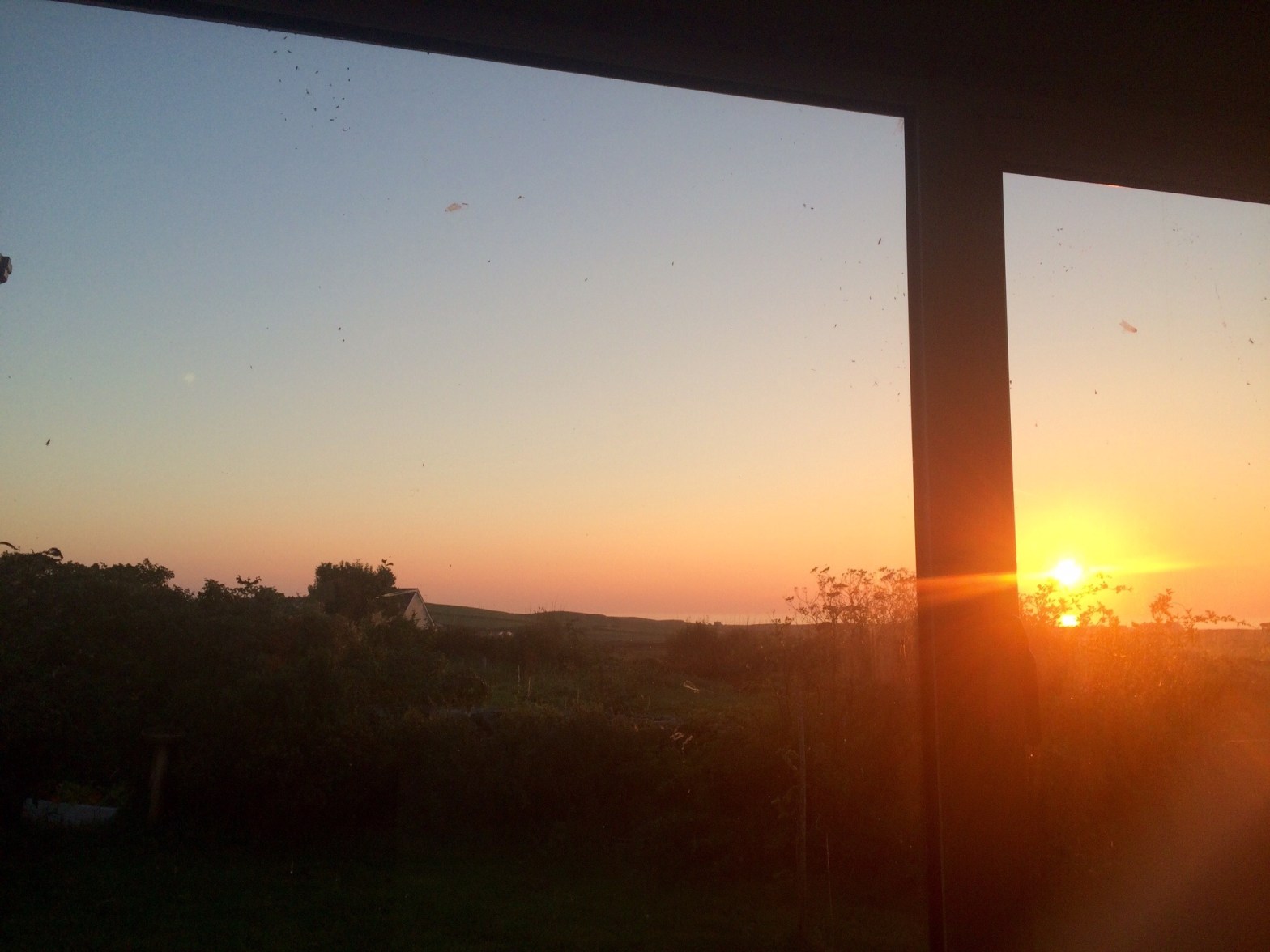
And then, as we sat on the pavement with our packs beside us, wondering casually how long we should wait until we started walking toward an unknown something, an older woman with short red hair, wearing an outfit of five shades of purple and yellow crocs, appeared suddenly, greeting us warmly, saying you must be my guests, welcome. We drove further still into the countryside, eventually rolling down a gravel road to find ourselves at a home full of potted flowers, books, and a fireplace burning blocks of peat, tucked into the rocky hill surrounded by sprawling fields dappled with sheep and the distant rush of the tide coming in against land’s edge. Sipping ginger tea around the wooden family table, we smiled as the setting sun shot streams of red and gold through the wide windows, blanketing this home — where we had suddenly found ourselves, realizing this would be the end of the story — in a hazy glow of light.
Our stories tend to end this way. The delayed last train finally arrives, the directions we asked for take us directly to the hostel door, a kind woman in purple shows up and welcomes us into a warm home by the sea, where the sun sets sparkling. And when they do end in this way, we walk through the next part of our journey, through the next moment we are able to laugh and call it an adventure, acknowledging and naming the whole story of life, grateful, deeply aware of the grand privilege it is to call it such, and with many, many others in mind.
But our privilege to fearlessly speed into the unknown and call it an adventure is not something that we simply name and appreciate before continuing on our carefree way, and so we go on living our stories and our end, living this adventure, asking many questions.
We ask: what is it to move beyond acknowledgment? With minds of gratitude as we walk through customs, how could we carry these passports in a way that takes care of others? Knowing adventure does not establish us as islands, who should we challenge ourselves to become, and what will we do, as, with bound well-beings, we speed off into the unknown?
Ranier Maria Rilke instructs that we “live the questions now” that we might “live along some distant day into the answer”.
In train stations, on buses, down confusing winding roads, crossing vast fields with glaring Irish cows, up mountains we aren’t entirely qualified to climb, these, among many, many more, are the questions we are living.
 callie daniels-howell
Callie, I love reading these! Your last paragraph is a manifesto for life.