I have always wanted for my research to create something beautiful, and now, placing our trust in each other, nine families of children with shortened and important lives and I have committed to doing so together.
But to do so, we need a broader community to join us. Children’s palliative and hospice care is inordinately underfunded, and non-clinical research in child death and dying, such as mine, is challenging to fund through academic grants, such that to date all of my research expenses have come out of my own savings. To undertake this effort fully, to be able to walk alongside these families to tell the stories of these 9 children whose lives were not long but which, I wholeheartedly believe, have the power to ease the suffering of others, requires a significant increase in resources. So we are asking for you to accompany us.
To try to summarise the last 7 months of life, work, and PhD research in Kenya seems a not only insurmountable, but fruitless task. It is not as though there is nothing to say. There is everything to say. But to distil it feels a disservice to both the magnitude and the complexity of suffering, of love, of effort, of sorrow, of continuing that I have been utterly privileged and acutely humbled to witness.
I entered my research in Kenya focused on deciphering the space between life and death for children dying from cancer. I held wonder about what might happen if I were to not simply observe from a distance the lives of children and their families as they entered into, persisted through, and, often, died from childhood cancer. I wondered what might be found, what might grow necessarily complicated if I were to instead participate in the work of mourning alongside, to accompany as families navigated the harsh, tender, volatile, mundane, confusing, and distinct space between.
I entered with no pre-determined guide nor any clear expectations for what this shift from observation to participation would actually look like or entail. It has been messy and difficult and not always clear, and also entirely natural. It has been not a matter of tick boxes and perfect delineations of this and that but of choosing each action, each word, each touch, each movement toward and each movement away, with the questions: what can I do for you to feel most care? How do I show you that if you trust me with your experience, I will keep it safe? What does it look like for me to stay in your reality, to not flee from it, to be fiercely present to you and your desires?
And what has come from it has been beautiful. Painful, yes. Challenging, incredibly so. But beautiful. In the past 7 months, I have witnessed the fiercest love, the most tender, wavering but still continuing courage and devotion, and the life of some downright tremendous children.
Through this process, as I spent the first phase of my research working full time in the childhood cancer ward, it became clear that I needed to push myself to open and relinquish even further in order to discover and create what is more true, more full, more ethical, and more just.
This meant that rather than work with many bereaved parents of children I did not know who died at least a year ago, I shifted to enter the tender space of working with the entire family and community of a small group of children who died within the last 5 months, whom I knew and loved and watched live and watched die during my time working in the ward, and whose families allowed me to do so. And, rather than approaching families with a preestablished goal or with a clear and controllable plan for what I wanted and how I wanted to get it, taking power from them, I chose again. Instead, I asked families to exercise power in collaboration with me, asking them to answer: what impact do you want the story of your child’s life to have? Who needs to hear that story in order for that impact to be realised? And how should we tell it in a way that most honours them and the change they are capable of making for others?
So it came to be that the families of nine children with shortened and important lives, who died with cancer in March and April of 2022, all agreed, with much consideration and careful questioning, to be part of this undertaking with us.
So in July we hopped in some 47 matatus, sped through mountains, across farms, and down dirt roads on 109 motorbikes, walked miles and miles, and said ‘thank you’ at least 200 times in 7 languages as we traversed Western Kenya visiting each of these families’ homes. We did not collect any data or conduct any official research or follow any topic guides but instead slowed down, sat down, sipped tea and said, ‘it is so good to see you again,’ and ‘my, how you cared for your child,’ and ‘oh, how we loved them’. To ask, ‘how are you doing?,’ ‘what has it been like?,’ and ‘how can we remember them?’
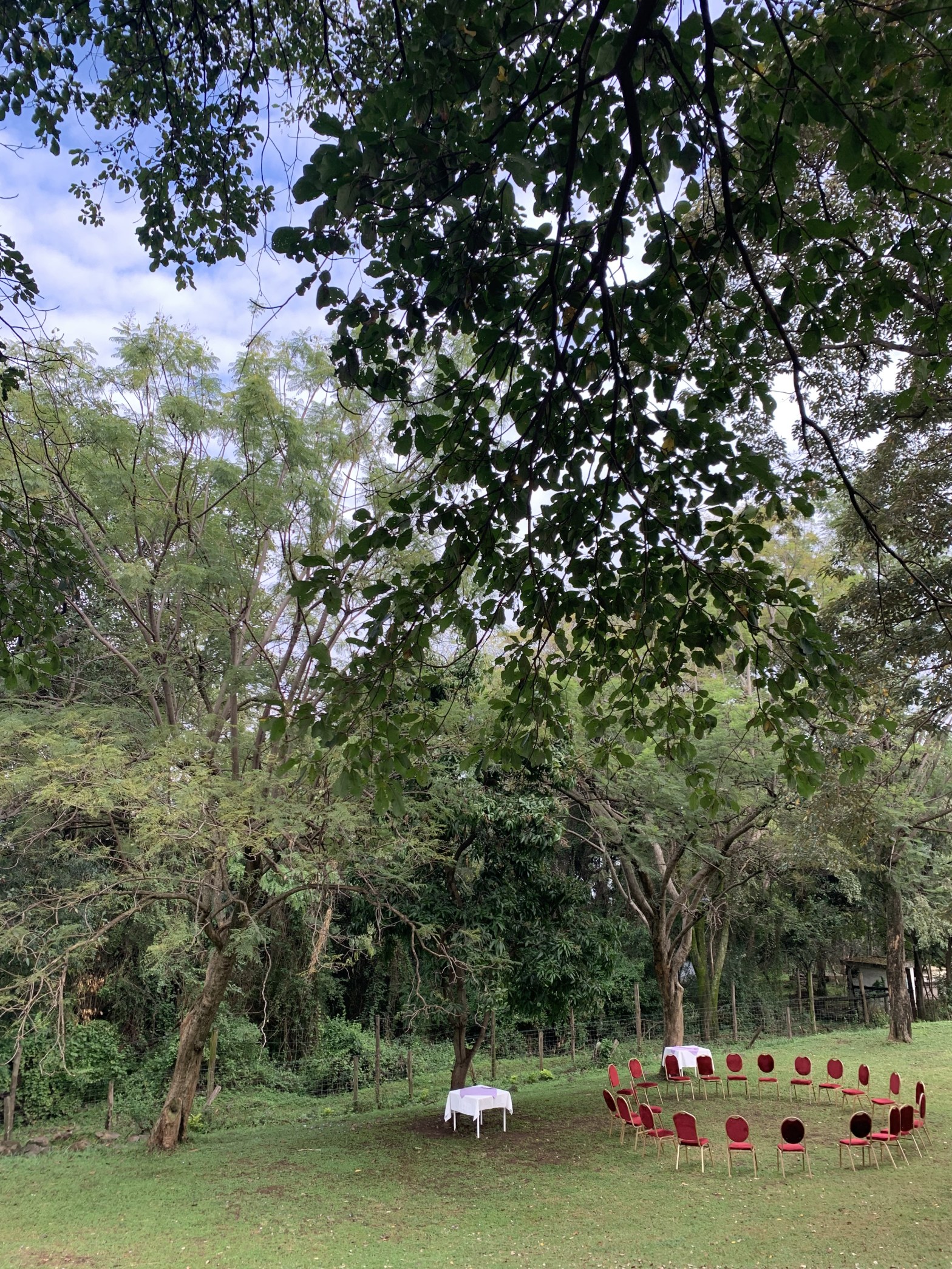
And in August, sitting in a circle under a canopy of trees by Lake Victoria, we watched these families, some who woke at 3am to make the long journey from their homes to gather together, cultivate a community amongst each other before our eyes, with tears and laughter and hugs and exclamations of remembrance. And we listened.
We listened as they told us that they didn’t quite yet know the single impact they would like their children’s lives to have because they hold so very many desires for what could have been for their own children and for those families who will one day also watch their children die. We listened as the families were quickly sure about one thing: they want people to look them in the eye, through recorded videos, as they tell of the their child’s life, death, and the space between the two. They want for people to see them, feel them, understand their silences and their sighs, their facial expressions, their little smiles and silent tears. They want to help us learn who their child was so that we might know what it is they lost and how we could care for them best before they went.
The families told us that they want to be able to film in multiple locations, showing us their burial places, their long and arduous journeys to seek diagnosis and care, their homes and the homes of those who loved them. They want their grandmothers and aunties and neighbours and church leaders to share their segments of the story. Some told us they want to use their mother tongues while others want to speak Swahili and others English, seeing languages as offering different opportunities for freedom and fullness in their expression. They told us they don’t know how to grieve and want support, asking if we could continue providing grief counsellors so that they could, alongside and separate from our research, have space to speak without conclusion among those who, too, have found their lives interrupted. They told us they want to take their time, asking us to return to their homes again and again over the next 6-8 months so that they can slowly, intentionally, and carefully speak the story into fullness, leaving nothing out. They told us that they want this group of families to form its own family, keeping in shared contact over WhatsApp and gathering periodically just to be together in their new whole.
And so, once again, opening ourselves and this research up to the messy unknown by saying both, ‘we want to accompany you’, and, ‘will you accompany us?’, we found ourselves living something gorgeous. We found ourselves learning tremendously from these families who courageously gave us their thought and opinion and desire, saying: we trust you to carry our children’s stories, to hold close our desires for change and to commit to seeing that through, and this is the way you can put care at the centre and front of it all.
But this requires substantial resources. To undertake this work, we need additional funds to cover: smart phones for families to be able to communicate with one another, video cameras to capture their stories, travel costs to family homes and group gatherings, grief counselling, translation and interpretation, and financial remuneration for the time and effort families are giving to participate. And we need help.
While certainly this isn’t quite the way I envisioned making my PhD possible, I also wonder if it’s the most true for this particular work – to say, yes, this is not the research that is easily funded and yes we are choosing to go the hardest way through this most tender and delicate topic that requires the utmost care for our participants, but we will not turn away. Rather, we will ask others to walk with us, to accompany us, so that the lives of O, E, D, S, E, S, R, D, and L can be remembered.
Will you join us?
To donate financially, please visit our GoFundMe. If you prefer to donate through other mechanisms such as check, cash, Venmo, or direct transfer, please contact Callie at calliedanielshowell@gmail.com or via WhatsApp at +2540757931128.
Asanteni sana, thank you all so much.
 callie daniels-howell