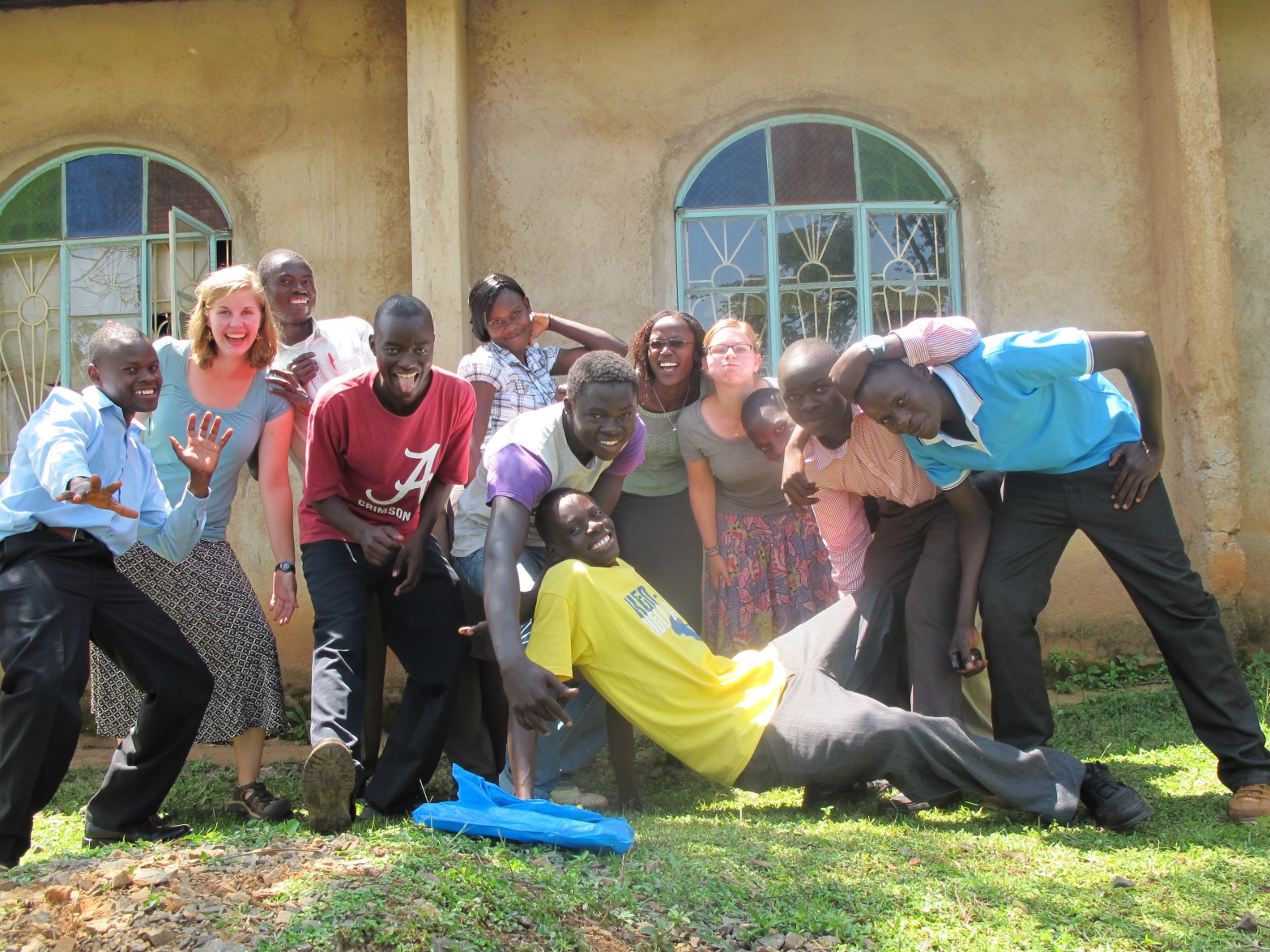
I’ve been feeling self-conscious recently about how much I talk about or bring up my time in Kenya. I worry that I have become the “well, when I was in Kenya…” girl. Potentially this is manifesting itself because three fourths of the junior class at my school just returned from their various study abroad experiences and are suddenly those “well, when I was on study abroad…” people. Potentially this is manifesting itself because at a very liberal, liberal arts college, white women going to African countries is constantly critiqued, judged, and frowned upon such that every time I speak about being in Kenya, I feel everyone in the room wondering if I’m “one of those missionary people”. Potentially this is simply manifesting itself because I miss Kenya so terribly recently that every time I bring it up, I am reminded of my desire to be there, which has led me to notice these occasions with much more prominence.
Regardless of the reason, I’ve been feeling self-conscious. The other day in class, before I contributed to a discussion about cartographic power, I prefaced with “I’m going to talk about Kenya again, but it’s only because that’s just what I relate to.” I’ve started to attempt to justify and explain away my thoughts, which are often of Kenya. In that same class, a cultural geography class called Space, Place, and Landscape, we were assigned an essay in which we were meant to discuss and critically analyze a ‘home-place’. I chose to write about Chulaimbo, Kenya, not only because I do feel such a sense of home there, but because throughout almost every class discussion on socio-geographical concepts, I am reminded of Chulaimbo and often see that class through the lens of my Kenyan home.
In writing the essay (below) I found confidence in my speaking about Kenya. Even more-so, my love for Kenya and Chulaimbo specifically grew in a new way. And it was a beautiful moment realizing how much I had learned about myself through a class assignment and to discover just how much this place means in me and the ways it continually shapes and reshapes my understandings of ‘senses of place’.
My paper (it’s long):
In the village of Chulaimbo, Kenya, I stand out. I do not blend into the space. Yet it is a home to me, a space which in the past four years has become one of the most beloved and meaningful places in my life. I might appear ‘out of place’ to those who view my “place-ballet” in Chulaimbo from a distance and who observe my presence in the village, as it relates and crosses with the “place-ballets” of the existing community, as a landscape. I do not fit in; I am an ‘other’ in many regards, particularly through race, gender, social class, and national origin. However from my viewpoint – which encompasses my close relationships, my life lived in community there, and the ways the place has created me – Chulaimbo is very much a home to me and a space where I have experienced the greatest sense of place in my life. Chulaimbo, Kenya is a home-place in my life because of my deep connection to the people who create and recreate the place daily and because of the ways it shapes my very being; this sense of place is in contrast to the ways in which, from the viewpoint of external places which are in relationship to Chulaimbo, my “positionality” in the space ‘others’ me.
Chulaimbo can be described and mapped in different terms according to what perspective is being used, for what purpose, and with what power. Geographically, Chulaimbo village rests directly on the equator and is situated in rural Western Kenya, just north of Kisumu town, on the eastern coast of Lake Victoria in East Africa. Politically, Chulaimbo is situated in Maseno division of Kisumu county of Nyanza province of the Republic of Kenya. Socially, Chulaimbo is an impoverished village with a high HIV prevalence, resulting in many child-headed households and households comprised of many, many children living solely with an elderly mama, the middle generation almost entirely lost from the disease. Locally, Chulaimbo is a 45-minute matatu ride (14-passenger van used for public transport) from town, and is nestled closely between Lela and Daraja-Mbili villages, all of which are part of ‘Luo-land’, the region of Kenya almost exclusively composed of the Luo ethnic group. Standing on the ground, Chulaimbo is dirt roads caked with red clay; it is lush, green farmland filled with maize, beans, and kale; it is the marketplace teeming with women buying and selling fresh produce, grilled maize with chili powder, and used clothing. Chulaimbo is made up of small, interwoven footpaths connecting family compounds, made up of small mudded homes, to mudded schools bursting with children reciting English phrases and Kenyan national history lessons. It is a slow and vibrant community; hospitality and kindness are of the utmost value.
In describing the hierarchal structures interwoven into the Chulaimbo landscape, one must observe the village as it relates to other places and to Kenya as a whole, as well the ways in which class structures are physically mapped onto the environment of Chulaimbo as its own place. Using a broad view, Chulaimbo is often set in contrast to Kisumu town or Nairobi city, where men go to work while their wives and children remain in the village or where one lives if they have enough wealth to subsist without land to farm. Kenya as a whole does not have a middle class; there are the extremely wealthy politicians and elite who reside in sprawling, city mansions and there are the poor who live in city slums or in rural villages and are divided between those in abject poverty and those which are slightly less poor. This is mapped onto the landscape of Chulaimbo through size of compound, land owned, accessibility to the road, accessibility to one’s compound by car, and the materiality of the compound itself. A family compound’s wealth can be judged from a distance: if the walls are painted or are made of mud, if there is a tin roof or a thatched roof, if there is a gate. More than just the aesthetics of a home, this gets at accessibility to infrastructure and basic necessities. If a family compound is not situated near a water source or land for farming, that family is reliant on the more wealthy, and therefore more powerful, persons in the community. Without easy or direct access to government built and maintained roads, one’s access to health care and business are minimized. More than just the appearance of a compound, structure or foot path, Chulaimbo’s landscape maps the difficulty of life, but also the perseverance of people whose compounds continue to survive, creating through their daily lives a place of great strength and beauty.
The “place-ballet” of Chulaimbo is performed through walking and illustrates not only the daily activities as they produce and reproduce Chulaimbo as a place, but also illustrate internal patriarchal and class structures which are at play daily. In Chulaimbo one walks daily to get water, one walks to bathe, walks to the shamba for weeding or harvesting, walks to the shop just down the path for bread and butter in the morning, walks to the outdoor kitchen to make hot, milky chai tea, walks to market to sell bright tomatoes and heavy sacks of coal, walks to the road to take a matatu into town for business, walks home after the afternoon rains have covered everything in red, thick mud. The market, which is passed through daily, fills with Women using Luo to greet others and barter with shillings for the best price. There is a constant flow of relationship as walking paths cross: hands are always shaken, one always inquires about the health of the family, and peace is always wished up the other in each interaction.
The personal impacts of gender roles and poverty are demonstrated through the daily routines of families. Children wake early to walk great distances to school in pleated, pressed, and scrubbed uniforms with small notebooks and pencils worn down to stubs where they sit in mudded classrooms, six to a desk, until lunch, when they all walk home again, often to find there is no food waiting for them to eat before they return to school with empty stomachs. Children too young or unable to attend school play in the shamba next to their mamas, babbling and giggling. In the evening, girls of all ages are sent to the kitchen to prepare the meal for the family, which is eaten together after a prayer in the home. Girls must then clean the dishes and the laundry for the next day, after which they are able to join the boy students as they do their studies next to the kerosene lamp. Mamas put their children to bed and prepare for the next day of hard work. Fathers are largely absent from this place-ballet for survival, spending their days either in the city looking for work or at the roadside bars which reek of local brew. Families are considered progressive and almost ‘out of place’ if the father engages and participates in the familial place-ballet which is seen as a woman’s territory. This familial ballet changes and is hastened with wealth, as electricity, vehicles, sinks with flowing water, and stoves ease the working hours.
When I am in Chulaimbo, my place-ballet wanders through and between these others, often with more flexibility as I have the privilege of walking not just for subsistence but also for experience. I am granted respect when I take part in the local place-ballet as fully as possible; I am accepted when I scrub the laundry by hand alongside other women for hours, receiving blisters and a sore back. When I walk to the market in the evening to fetch coal, carrying it on my back for the two-mile journey, I am considered a part. It is in the continual choice to engage and be active in, rather than simply observe, this performance that I have come to learn and to love Chulaimbo.
In performing this place-ballet alongside my friends and family in Chulaimbo, I have grown to know that I am home in this place because of the ways it has shaped and shapes who I am and the ways I attempt to live out my life in every space. Chulaimbo makes me feel alive in a way which I hadn’t experienced before stepping onto its soil in 2009. When I am in Chulaimbo I feel welcomed, I feel strong, I feel better, all largely because I feel connected. I, a shy introvert, have friends there; I feel a family among the people of Chulaimbo. I am supported and I support, I am strengthened and I strengthen, I am enlivened and I enliven. As I walk through my daily “place-ballet” in Chulaimbo, I am at ease and I am a part. Chulaimbo is where I learned and became myself; it is the place where my passion lies. My well-being is bound up in the well-being of Chulaimbo and that constitutes “home” in my experience. This deep sense of self, felt through being a living member of this place, was created and is recreated through my place-memories of Chulaimbo. It was in Chulaimbo that I learned of the first child I knew dying, it was in Chulaimbo that I danced in a sunny classroom with students and felt heart-bursting joy, it was in Chulaimbo that I have felt and continually feel most challenged to live a life of grace and compassion. My drive to act in kindness, my ability and desire to hold a conversation, my value placed and family and relationship all stem from the community I feel and the ways I am taught as the people of Chulaimbo allow me to be among and share the place we create and are creating together.
When I am in Chulaimbo, my ‘positionality’ is inseparable from my race and national origin. I am often the sole white person in the area, and almost always the sole white person living in the village, traveling the footpaths, eating local food and walking the daily place-ballet among Kenyans. Most other white persons who come into the space visit from the city, where they stay in ‘Americanized’ guest houses and move within a Western, tourist orb. My race and national origin place onto me an assumed – and accurate – higher social class, which causes me to be often asked for money or for the letter of invitation required for an American visa. Walking down the road or into a new place, interacting with an unfamiliar seller in the market or riding in a new matatu: in all of these activities I am inscribed with the name “mzungu” (used synonymously for white person and foreigner in Swahili) until I take the time to create a relationship, give my name, and ask to be called by it rather than this label used for all persons unknown and different.
In a patriarchal, rural society, my experience in Chulaimbo is shaped, as is the experience of all women there, in relation to men. Yet my experience of this is vastly different than that of most Kenyan women, as my race trumps all other qualifiers given to me and allows me privileges many Kenyan women never receive. I am given access to spaces that the majority of women, unless they are wives of the elite, are unable to experience. Once I attended a large fundraising event and was seated with Kenyan women throughout the ceremony until I was told by one of the women that I was to attend the meal for the members of parliament and other male politicians. The only other women in the room were cooking and serving us, as I sat at a table that was only afforded to me because I was a mzungu. Politics are not considered a place for women in Kenya, but are considered a place for the powerful which, as an American, I am in Kenya, regardless of my choices to not exercise that power actively. While my whiteness grants me access to certain spaces in Kenya, it also associates me eternally with somewhere else. I am never truly in place and am positioned outside. Despite my deep love for this home-place, my experiences there will in some way always be shaped and influenced by my race, gender, and national origin. In acknowledging this and continuing to be in relationship with the people and the place as I experience it, I am able to maintain my “positionality” in a genuine manner, as opposed to much of the other international flows through the space.
The flows in and out of Kenya, both in the form of goods and in people, often illustrate exploitative relationships with the country which reproduce historic colonialist flows and inaccurate images of Chulaimbo. There are international flows of goods in and out of Kenya and in and out of Kisumu; often these flows touch Chulaimbo, but do not directly involve it. Primarily these goods are in the form of used clothing and accessories, shipped in crates on ships to the Mombasa port on the Indian Ocean and then distributed to cities throughout the country. Slowly, these make their way into small village markets, where they are sold informally again for fractions of dollars. To acquire a business or medical profession in which one might interact with flows of external ideas, money, or people, one must leave Chulaimbo to the capital city, or to a Western university. Other forms of connections come in the form of international aid of various forms and shapes. Some is truly a connection, in which persons from the outside are working with those from the inside to form a shared place to promote goodness. Some are more similar to an invasion on the space by the outside that remains unknown and distant. To become a connection rather than a simple flow, one must stick around and implant oneself; belonging occurs when one immerses in the place-ballet, rather than performing one’s own ballet on top of what is ingrained.
An image of Chulaimbo is produced and assumed by others, particularly the West. This image is not created in relation to other small Kenyan villages or in relation to Kenyan cities or in relation to East African nations or in relation to the continent as a whole, but by the relationship of Africa to the West. This is produced continually through the media, through news sources, through persons flowing in and out of the continent who bring back landscape views which are pasted as reality onto every space in Africa by virtue of the outsider’s power to do so. This image of a single African place, which conjures images for all, is used to acquire money, sympathy, and glory by those who exercise it. I am often told I am brave and courageous for going to such a mysterious and dangerous place. I have been asked if I have to camp in the wilderness when I go to Chulaimbo, I have been asked if people sleep in trees there, I have been asked if I have to bring my own food so I don’t starve, I’ve been asked if I just always feel sad there looking at the poverty, I’ve been asked how I manage in such a hopeless place. In thinking of place as a space with meaning and memory and connection attached to it, I find that those persons which make such remarks and ask such questions should be framing their images in terms of the space of Chulaimbo, for if one had ever been a part of its place, one would never term Chulaimbo ‘hopeless’.
In many ways, I am an ‘other’ and ‘out-of-place’ to Chulaimbo. My race, gender, social class, and national origin place me externally to Chulaimbo such that I will always stand out there, by virtue of looking the minority and by the privileges I am afforded which are unattainable for most that live there. Chulaimbo is produced through the quick flows of persons in and out of the entire African continent, rendering it a space which has an incomplete sense of place unless one plants oneself there and incorporates oneself into the often survival-based place-ballet of life in the village. In creating my place-memories of Chulaimbo in this way, I have come to experience it as a place of great meaning, of reciprocal relationships, and of a deeply-rooted home.
 callie daniels-howell